Colours in their order
A rainbow always keeps the same order: red, orange, yellow, green, blue, indigo, violet. Some people remember it as a made-up name, some as a silly sentence, and children often invent their own. Lay out the crayons in rainbow order before starting the colouring page, where two friends draw rainbows in chalk on the ground, and colour each stripe in turn. Then try the trick backwards, from violet to red. Ask which colour is hardest to name. Indigo usually wins, and it is a good excuse to look at a pair of jeans or the sky just after sunset. Keep the crayons in rainbow order in their box afterwards. It makes tidying up a small puzzle of its own, and the next person to open the box will notice straight away if a colour is missing.
- Line up the crayons first
- Try the order backwards
Make a real rainbow
Rainbows appear when sunlight passes through drops of water and splits into its colours. You can make one at home. On a sunny morning, stand a glass of water on a windowsill and put a sheet of white paper on the floor below it; a small rainbow often lands on the paper. Outside, spray a garden hose into a fine mist with the sun behind you. Colour the rainbow sheet afterwards and compare it with the one you made. Was the red on the outside or the inside? Most rainbows put red on the outside. Keep a notebook of every rainbow you spot over a month, with the date, the time and the weather just before it appeared. Older children often notice that most rainbows come in the late afternoon.
- A glass of water on a sunny sill
- A fine mist with the sun behind you
Chalk rainbows outside
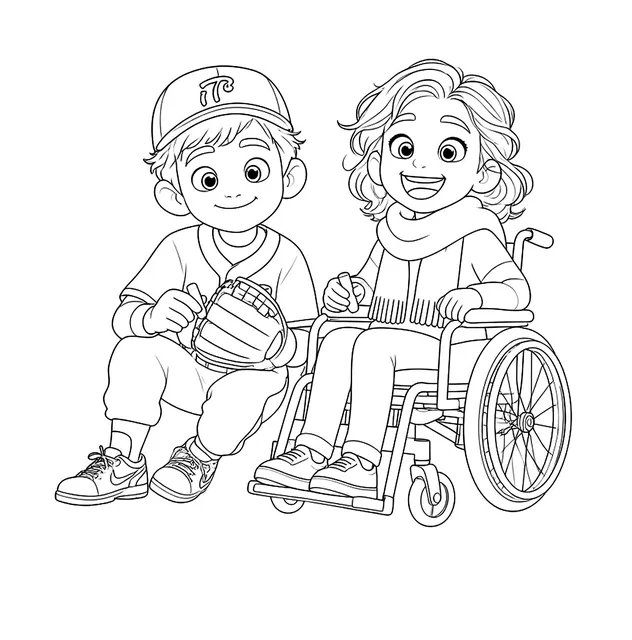
The colouring page shows a boy in a cap and a girl in a wheelchair sitting on the ground drawing rainbows in chalk, and it is an invitation to go and do the same. Take a box of chalk to a path, a yard or a playground and draw rainbows big enough to lie down beside. Wheelchair users, toddlers and grandparents can all reach the ground from where they are, so everyone joins in. When the rain comes and washes the chalk away, come inside and colour the paper version, which stays put. Take a photo of the chalk rainbows before they wash away and print it beside the coloured sheet. Children like seeing the two together, the big one on the ground and the small one on paper.
- Big enough to lie down beside
- The paper one survives the rain
A window of hope
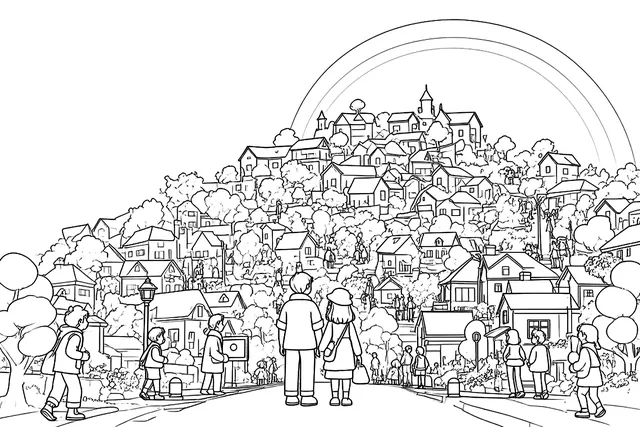
Rainbows in windows have meant many things to many people: good luck after rain, a hello to neighbours, a sign that everyone inside is doing fine. Colour the rainbow page with felt tips or watercolours so the light comes through, and tape it in a window facing the street. Count how many other rainbows you spot on your next walk. In a classroom, each child can colour one and the whole row can go up along the windows together, every name on its own rainbow, so the class looks bright from the playground too. Neighbours often stop to say they noticed a rainbow in the window, and it can be the start of a friendly hello. In a care home or a hospital ward, the same rainbow cheers up the corridor.
- Felt tips let the light through
- A whole class row along the windows
Weather words and puzzles
The activity pack is full of weather: mazes inside a rainbow’s arch, where the first sends a raindrop to find the sun, a cloud and a kite to match to their shadows, raindrops to count, and a hot-air balloon that appears from the dots. Use it to learn weather words. Each time a sheet shows rain, say a word for it: drizzle, shower, downpour. Each time the sun appears, say one for that: bright, clear, warm. Older children can keep a week’s weather diary with a small picture for each day. Match the kite on the shadow sheet with a real kite on the next windy day, or make a paper one with a stick and string. Watching it climb is the best way to understand what wind can do.
- A weather word for every sheet
- A week’s weather diary
Butterflies and paintbrushes
The rainbow memory cards pair paintbrushes with butterflies, two things that are all about colour. Print them on card and before cutting them out, colour every butterfly differently, so the game becomes about matching colours as well as pictures. Six pairs work for the youngest players, twelve for most school-age children and eighteen for anyone who likes to win. At a party or a club, finish with a painting table where everyone paints a butterfly of their own, folded in half while wet so both wings match. Play one last game at the end of the day where each player names something real in that butterfly’s colour before turning the next card. The game slows down, and everyone looks round the room.
- Colour the butterflies before cutting
- Fold-painted butterflies to finish